
Phrase moderation and punishment chains
A builder for phrase rules with connectors, distance and exceptions, rule sets, punishment chains, and two simple blocks — text length and duplicates.
The most common request after the dashboard launched was a simple one: "let us delete messages by words". We built a rule builder rather than a stop-word list, because a list of words either misses half the spam or starts taking out real conversation.
The rule builder#
A rule is assembled from parts connected to each other. A part is a phrase, a number, or a whole group of other parts. Between any two parts there is a connector: OR, or AND with a maximum distance.
This rule fires when "swap" or "p2p" appears no further than forty characters from "usdt" — and stays quiet when the words simply happen to share one long message.
What else the builder can do:
- exceptions — a part with a minus sign cancels the match:
"buying" &10 "account" & -"buying from you"; - strict order — with it, parts must appear in exactly the order written;
- groups — brackets let you nest conditions as deep as you need;
- numbers —
{n}catches any number, from "500 USD" to "t.me/+15550123456".
While you edit a rule, the dashboard highlights the matches in your test string. You see the mistake before it reaches the chat.
Every connector explained, with "catches / lets through" examples, is in the guide How to set up a word filter in a Telegram group.
Rule sets#
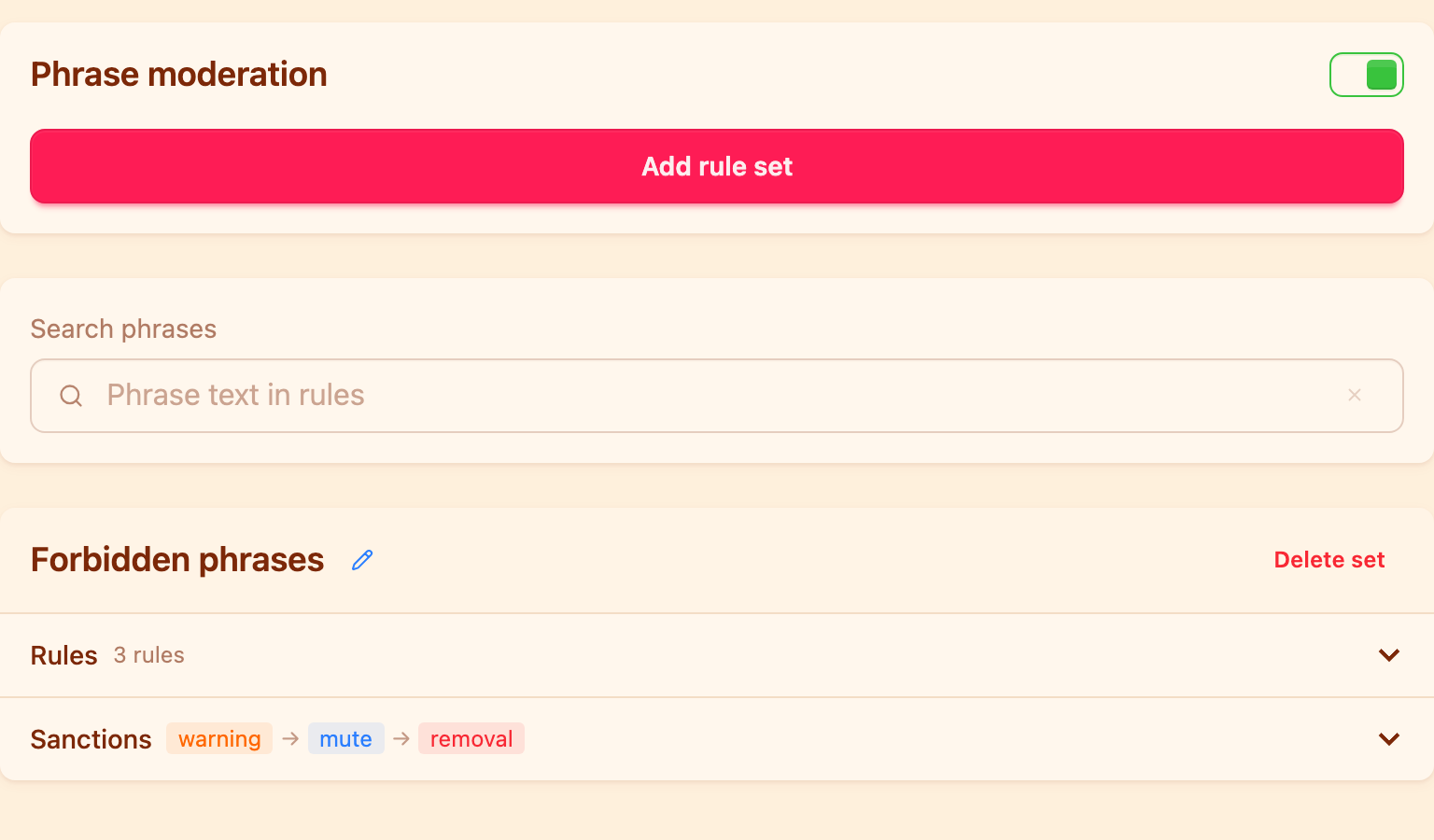
Rules live inside sets that you create and name however you like — by topic, by source of spam, whatever fits. The split is not cosmetic: the punishment chain belongs to the set. Some things can earn an immediate ban, others only a warning, and the violation counters of those sets never mix.
Every rule and every set can be switched on and off separately, so you can mute a whole set for a while without deleting its settings.
Punishment chains#
A chain describes what the bot does on a first violation, what on a second, and so on. You get as many steps as you need: one is fine, or build a ladder of "warning → one-hour mute → one-day mute → ban". When there are more violations than steps, the last step repeats — so a chain without a ban at the end does not quietly turn into an amnesty.
Each step has its own settings: whether to delete the message, where to send the warning — to the chat, to direct messages or as a message only the offender sees — and how long the mute lasts. Every rule set has its own chain. The set's card shows that chain in full, with a hint about which step a given member is on, so you do not have to keep the logic in your head.
Text length and duplicates#
Two simple blocks arrived alongside phrases, and they take out a noticeable share of the noise before it ever gets to word matching:
- Text length — cuts off empty messages, one-word spam and walls of text;
- Duplicates — catches both one member repeating themselves and the same text sent at once by different accounts.
Read next
 Updates2 min read
Forums: separate moderation in every topic
Every forum topic gets its own moderation settings, AI rules and balance spend, while the chat-wide settings stay the minimum for all.
 Updates2 min read
Member trust
Every member now has a trust level, from very low to very high. The bot is stricter with newcomers, and long-timers can be skipped.
 Updates4 min read
AI moderation grew a settings panel
Your own rules in plain words, a separate punishment for every topic, control over what the balance is spent on, and auto top-up.