
Warning, mute, ban: setting up punishments
A chain decides what happens on a first violation and when the counter resets. Steps, warning delivery, amnesty and manual review.
A rule only finds a violation. What to do about it is decided by the punishment chain — and until that is set up, the rule stays silent. This is the most common reason behind "the bot does nothing": the phrase set is built, the block is on, and there are no punishments.
Where to set it up#
A chain belongs not to the chat as a whole but to a rule set: a phrase set has one, a link group has one, every AI moderation topic has one. You open it from the set's card — "Punishments for violations".
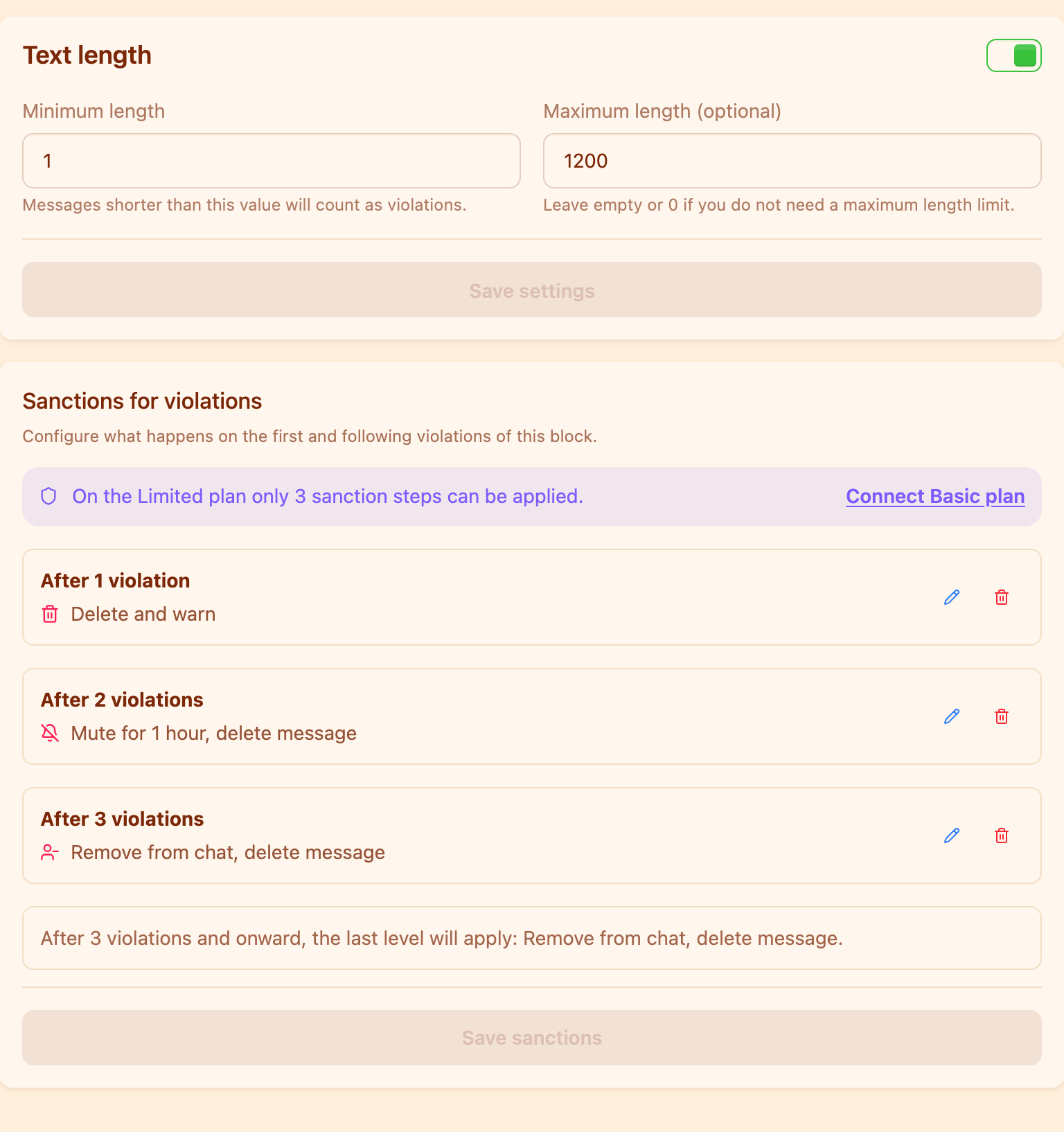
That is why advertising and profanity can be punished completely differently, and why the violation counters of different sets never add up into one.
How a step works#
A chain is a list of steps in the form "after N violations". You can add as many steps as you need; when there are more violations than steps, the last one repeats. The dashboard says as much under the chain: after so many violations and onwards, the last level applies.
Each step picks a main action:
| Action | What happens |
|---|---|
| No punishment | extra actions only — delete the message, send a warning |
| Mute | temporarily blocks writing |
| Remove from chat | kicks the member, who can come back |
| Ban | blocks the member |
| Send to administrators for review | the bot does not punish, it writes to you |
Mute and ban are set in minutes; an empty field means "forever". A ban has an extra checkbox, "delete all of the user's messages", for spammers who managed to spread ads across the whole chat.
Extra actions#
Any step, even "no punishment", can add two actions: delete the message and send a warning.
The warning is more interesting than it looks, because it has four delivery options:
- to the chat — everyone sees it;
- to the chat, offender only — the message is posted but only one person sees it; the chat stays clean and the point still lands;
- to direct messages — arrives only if the member already has a conversation with the bot;
- do not send — the punishment is applied silently.
You write your own text, and you can mention the offender inside it. For warnings posted to the chat it is worth enabling auto-delete: from one minute to a day. Only the bot's message is removed — the punishment itself and the member's message stay as they are.
Amnesty, so the counter does not grow forever#
A separate setting, "reduce level after", runs from half an hour to a week, or "do not reduce". Without it, someone warned a year ago gets the second step of the chain for their next slip.
For a living chat amnesty is close to mandatory. A reasonable starting point is a day for small stuff like profanity and a week for advertising; for scam sets it is usually switched off entirely.
The "send to administrators for review" step#
A special action: the bot does nothing itself and instead sends a card to direct messages — to the owner and to those administrators who have "Moderation alerts in Telegram" enabled. A human decides.
This makes a good first step where the cost of a mistake is high, and a good way to live with a new rule set for a week before trusting it with bans.
Ordinary groups are different#
If the group is not a supergroup, Telegram can neither mute nor issue a temporary ban. The dashboard warns you right on the step: the mute will be skipped and the ban will be permanent. The setting is still saved and starts working by itself once the group becomes a supergroup.
Where to start#
A working chain for a "profanity" set in an ordinary chat:
- after 1 violation — no punishment, delete the message and warn the offender only, auto-delete after 5 minutes;
- after 2 violations — mute for 60 minutes, delete the message;
- after 3 violations — mute for a day;
- reduce level after 1 day.
For a scam set it is simpler: the very first step is a permanent ban with all messages deleted, and amnesty switched off.
Punishments are half the job; what to catch in the first place is in the overview: how to protect a Telegram group from spam.
Why does the bot find a violation but do nothing?
The set has no punishment chain. Until it has at least one step, the rule fires to no effect. The same goes for your own AI moderation rules.
What happens after the last step of the chain?
The last step starts repeating. A chain that ends with a warning will go on warning — the bot will not escalate to a permanent ban on its own.
How do I stop old violations from counting forever?
Set "reduce level after", from 30 minutes to a week. After that time the violation counter drops by one step.
Can I warn a member without the whole chat seeing it?
Yes, choose the "to the chat, offender only" delivery. The message appears in the chat but only they can see it.
Why does the mute not work?
Most likely the group has not been converted to a supergroup — an ordinary group gives Telegram no way to restrict posting. The step is skipped, and the setting starts working after the switch to a supergroup.
Read next
 Guides5 min read
How to moderate a Telegram forum topic by topic
How to give each forum topic its own rules, why a topic can only be stricter than the forum, and what the General topic really is.
 Guides5 min read
How to tell the bot in your own words what to delete
AI moderation rules are written in plain text. How to phrase them, what the model sees, and how to test a rule in the simulator.
 Guides4 min read
Why the bot deleted your message, and how to contest it
How a member finds the reason with /why, how to file an appeal, and how an administrator handles complaints without digging through the chat history.